

How to Improve Garri Production Yield with Efficient Cassava Processing Equipment
For the garri processing industry in Nigeria, production yield bottlenecks are a common challenge. With the same ton of cassava, some factories can produce 800 kilograms of garri, while others only manage 500–600 kilograms. Where does the difference come from? Mostly from equipment and processes.
In this article, Henan Jinrui will clearly explain two things: First, how do traditional cassava processing methods limit garri yield? Second, how can you use efficient cassava processing equipment to truly increase garri production?
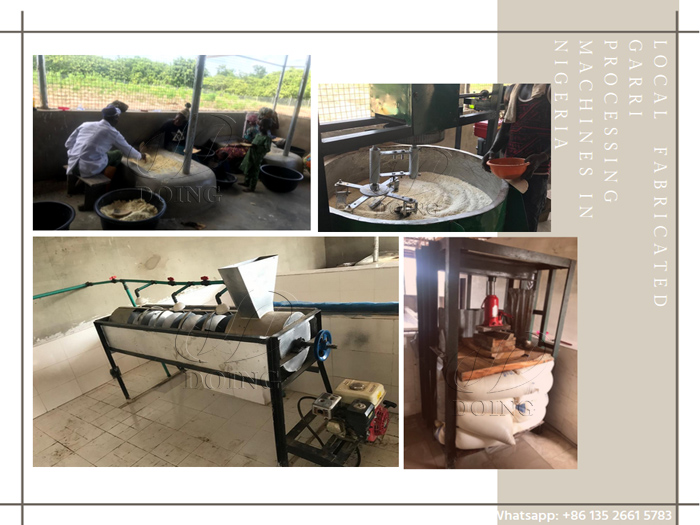 Traditional garri processing
Why Can’t Traditional Cassava Processing Achieve Higher Garri Yield?
Many garri processors in Nigeria have faced this situation: you bring in a ton of cassava, work hard through the whole process, but end up with very little finished product – and on top of that, you often get burnt lumps, undercooked particles, and uneven sizes. Garri production yield stays low, and the main reason is outdated cassava processing equipment and processes. Specifically, traditional processing has several common problems:
1. Incomplete washing and peeling
With manual washing or simple machines, sand and skin are not thoroughly removed. Crude fiber gets mixed in, affecting not only the taste and whiteness but also wasting usable cassava flesh. Raw material that could have produced more garri is simply thrown away.
2. Incomplete grating
Old, slow-speed grating machines fail to break down cassava properly. A large amount of starch remains attached to the fiber pulp and gets discarded. This loss is significant and directly lowers the conversion rate from cassava to finished garri.
3. Uneven dewatering
Without proper cassava pressing equipment, moisture control relies on experience. If moisture is too high, the fermentation process goes wrong, leading to some raw material being wasted.
4. Roasting depends on experience
Manual roasting or using traditional open pans means the heat is all about the operator’s feel. One batch is burnt and bitter, the next is undercooked and hard. The pass rate of finished garri yield is painfully low, and many semi-finished products end up as waste.
Simply put, without reliable and efficient cassava processing equipment, even the best cassava won’t yield much. To truly improve garri production yield, the first step is to replace these outdated processes and equipment.
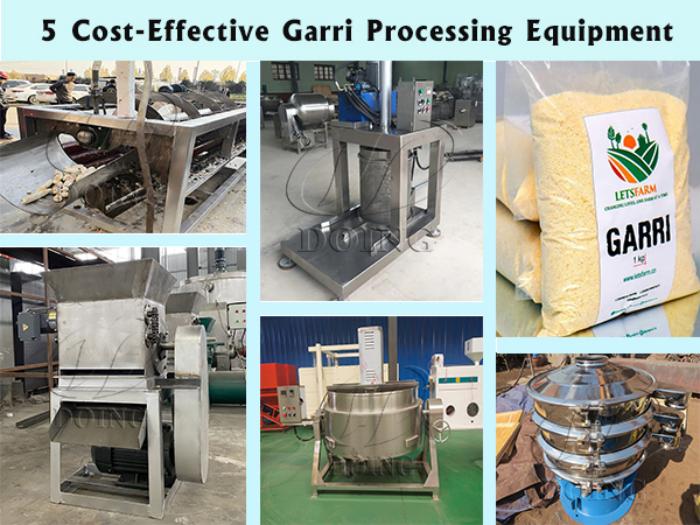 Cassava processing machine for garri production
2. Boost Garri Production Yield with Right Cassava Processing Equipment
Now that we’ve covered the problems with traditional processing, let’s talk about solutions. How can you truly increase garri production yield with efficient cassava processing equipment? It doesn’t have to be complicated. Just upgrade the equipment for the key steps below, and you’ll see the difference.
1. Automatic Peeling Machine
Switch to a professional cassava peeling machine. Processing capacity easily jumps from 100 kg/h to 1 ton/h, with a peeling rate as high as 96% – and without damaging the flesh. Compared to manual peeling, material loss is much lower, and raw material utilization increases by 8% to 15%. Cleaner peeling also means better whiteness and appearance for your final garri.
2. High-Speed Grating Machine
Grating is a critical step for garri production yield. Henan Jinrui’s grating machine uses a spike roller crushing technology, achieving a crushing rate of over 90%. Cassava is instantly turned into a fine, uniform pulp. The more fully the starch is released, the more garri you get in the end.
3. Hydraulic Dewatering Press
Fermented cassava pulp contains too much water and needs to be pressed. Manual pressing or traditional methods are tiring and uneven. A hydraulic press allows you to adjust pressure and time, keeping moisture content stable within the optimal range. For example, Henan Jinrui’s hydraulic dewatering press requires just one button to complete fast dewatering. The moisture content after pressing is around 40%, which is perfect for the subsequent frying step.
4. Intelligent Garri Fryer
The biggest fears when frying garri are burning and undercooking. Henan Jinrui intelligent garri fryer features constant temperature control, with simultaneous heating and rotating stirring. Every garri particle is heated evenly. No more burnt or raw batches – the finished product comes out golden and uniform. Plus, it supports continuous feeding and discharging, producing several times more per day than manual frying.
5. Fine Sifting Machine
After frying, garri contains some fine powder and occasional clumped particles. A sifting machine uses multi-layer screens to separate them.Qualified garri is directly bagged, while fine powder and coarse particles can be recycled for reprocessing. This way, every batch of garri has uniform particle size, looks good, and nothing goes to waste.
Improving garri production yield doesn’t require magic – just the right cassava processing equipment. By replacing outdated manual methods with efficient machines for peeling, grating, dewatering, frying, and sifting, you can significantly reduce material loss and increase finished garri output. Henan Jinrui’s complete line of cassava processing equipment is designed to help you achieve higher garri production yield with less waste and stable quality.
Ready to boost your garri production yield? Contact Henan Jinrui today for equipment recommendations and a free quote tailored to your needs.