

Cassava Starch Market Forecast 2025-2035: How Suppliers Can Capture the Opportunity
ADM, Cargill, Ingredion, Roquette, and Tereos — the world’s largest food ingredient companies, with combined revenues exceeding $150 billion — are collectively moving into cassava starch processing. Their entry is a powerful validation: cassava starch is evolving from a regional agricultural commodity into a globally strategic industrial raw material. If you are involved in cassava starch production, trading, or investment, you need to understand what it signals.
At Henan Jinrui — DOING Holdings, we have watched this shift unfold across more than a decade of supplying cassava starch processing equipment to emerging markets — and this article explains where the market is heading between 2025 and 2035, and how suppliers can position themselves to win.
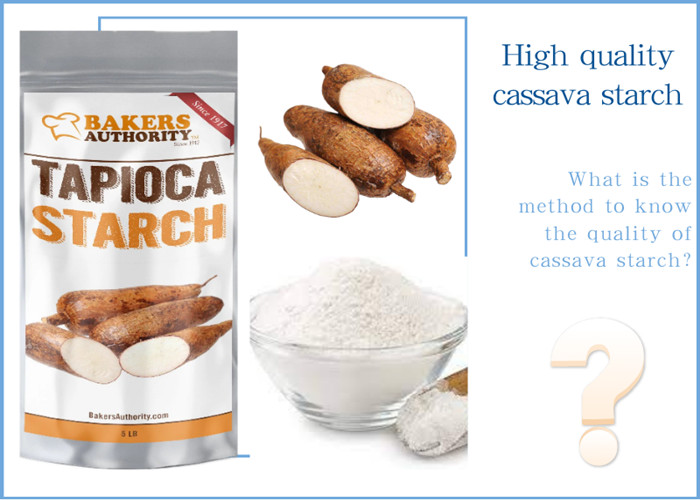 Cassava starch production
A Decade of Strong Growth — By the Numbers
The global cassava starch market is entering a decade of strong, structural growth:
| Market Segment | 2025 Value | Projected Value | CAGR | Source |
| Global cassava starch | ~$6.1 billion | $9.6 billion (2035) | 4.69% | IMARC Group, Cassava Starch Market Report (2025) |
| Modified cassava starch | ~$2.53 billion | $4.12 billion (2034) | 5.58% | Mordor Intelligence (2025) |
| Organic cassava starch | ~$3.3 billion (2024) | $4.7 billion (2030) | 5.9% | IMARC Group, Organic Cassava Starch Market Report (2025) |
These are not cyclical spikes. They are structural trajectories driven by consumer preferences, regulatory shifts, and industrial demand that will only intensify over the next ten years — and the fastest-growing segments are the higher-value ones: modified and organic cassava starch are both growing faster than the overall market.
Why the Market Will Boom — Three Core Drivers
1. Expanding Applications Across Industries
Cassava starch is no longer just for traditional foods. Its neutral taste, excellent thickening properties, and gluten-free, non-allergenic profile make it a preferred ingredient in clean-label bakery, noodles, sauces, dairy, and confectionery. In industrial settings, it is increasingly used in biodegradable plastics, adhesives, textiles, paper, and even pharmaceutical excipients.
This is the critical link between applications and market growth: every new application adds a new demand pool — food demand grows with population, clean-label demand with health trends, and bioplastics and industrial demand with green regulation. The more diversified the application base, the more resilient — and faster-growing — the market becomes.
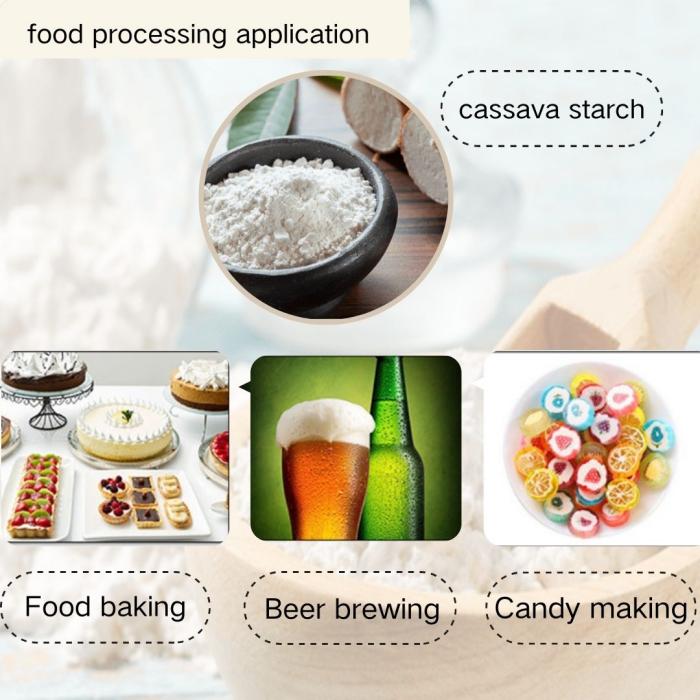 Cassava starch market
2.Supportive Government Policies Worldwide
Governments are actively backing cassava as a strategic crop — and several of these policies target cassava starch specifically. Each one touches a different link in the starch value chain:
China — demand side. China imports over 10 million tons of cassava products annually (FAO, 2024), much of it processed into starch; RCEP tariff cuts have already lowered import costs by an estimated 12% in Guangxi, making imported cassava starch cheaper and more competitive.
Côte d’Ivoire — consumption side. The government subsidises domestic cassava starch for bakeries, directly stimulating starch consumption.
Nigeria — capacity side. The cassava industrialisation programme aims to unlock over $800 million in economic value (Federal Ministry of Agriculture and Rural Development, 2023), largely by building new starch processing capacity.
Thailand — standards side. The largest exporter has pledged a 30% greenhouse gas reduction in its cassava sector by 2030 (Thailand Ministry of Agriculture, 2024), raising production standards that buyers will increasingly expect from all suppliers.
Together, these policies work on demand, cost, consumption, capacity, and standards at once — which is why government support translates directly into faster cassava starch market growth, not just more cassava farming.
3. The Giant Endorsement
When ADM, Roquette, and Tereos each independently decide to invest heavily in cassava starch supply chains, it is the clearest market signal possible. Their entry raises the bar for quality, documentation, and logistics — forcing the entire industry to professionalise. For suppliers who can meet these higher standards, this creates an unprecedented opportunity to become preferred partners in a maturing global market.
How Suppliers Can Capture the Opportunity
1. Invest in Modern Processing Equipment for Quality and Scale
The global giants are looking for consistent, high-volume, traceable cassava starch suppliers. If your equipment is outdated or your output is unstable, you will not make the cut — regardless of how strong the market forecast is.
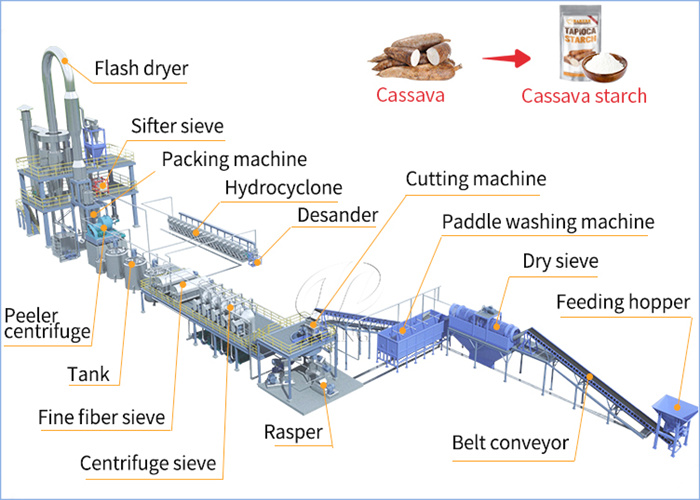 Cassava starch production line
A modern cassava starch production line is a complete, integrated system, not a single machine. Understanding what it comprises is the first step to planning your investment:
The core processing train:
Washers — remove sand, soil. Fresh cassava arrives with 5–10% attached soil, and washing efficiency directly affects starch purity.
Crushers and raspers — break the root cells to release starch granules. Rasper design determines starch extraction yield, which typically ranges 92%-98% in well-configured lines.
Fine fibre screens and desanders — separate starch milk from fibre and residual sand. This stage determines the fibre content and ash content of the final starch.
Hydrocyclone stations — purify and concentrate the starch slurry. Multi-stage hydrocyclone batteries are the industry standard for reaching food-grade purity (99%+ starch content).
Peeler centrifuges — dewater the purified starch slurry.
Flash dryers — reduce moisture from ~35% to 12–14% in seconds, preserving starch quality and preventing discoloration.
Packaging units — automated bagging with moisture-proof liners for export-grade presentation.
Learn more about the complete processing stages: [cassava starch production line overview →]
2. Move Up the Value Chain — Beyond Commodity Starch
Ordinary industrial starch offers thin margins. The real profit lies in food-grade, organic-certified, and modified cassava starches. Premium European food-grade starch commands 2.3 times the price of standard Southeast Asian product. The organic cassava starch market alone is set to grow from $3.3 billion (2024) to $4.7 billion by 2030. Investing in R&D, obtaining certifications, and developing customised modified starches for specific customer needs will differentiate your offering and boost profitability.
3. Seize the Supply Chain Diversification Window
Thailand still supplies over 70% of internationally traded cassava starch (FAO, 2024) — but the new demand from global players is too large for any single source to meet. This opens a historic door for suppliers in Nigeria, Indonesia, Brazil, Vietnam, and other emerging producers. Nigeria, as the world’s largest cassava grower, is rapidly expanding its processing capacity. Indonesian exports grew 27% in 2025, and Brazil’s rose nearly 14% (UN Comtrade, 2025). For suppliers in these regions, now is the time to establish robust quality management systems, obtain international certifications, and build direct relationships with multinational buyers.
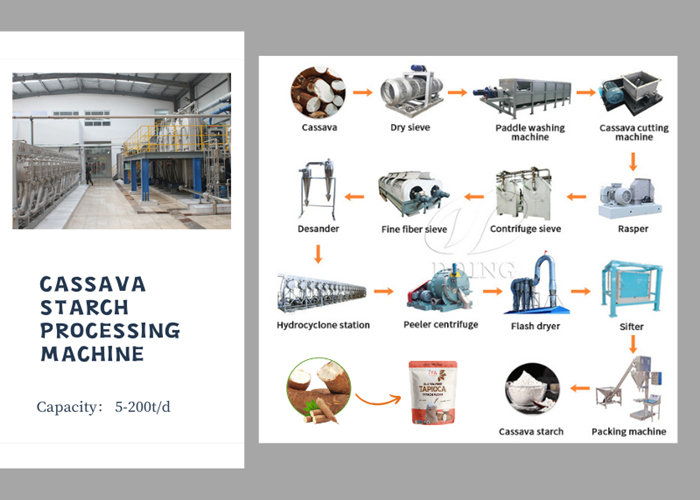 Tapioca starch making line
Frequently Asked Questions
Q: How big will the cassava starch market be in 2035?
A: According to IMARC Group (2025), the global cassava starch market is projected to reach approximately $9.6 billion by 2035, growing from ~$6.1 billion in 2025 at a 4.69% CAGR.
Q: Which cassava starch segments are growing fastest?
A: Modified cassava starch (5.58% CAGR, Mordor Intelligence 2025) and organic cassava starch (5.9% CAGR, IMARC 2025) are both growing faster than the overall market, making them the highest-value opportunities.
Q: Why are global giants like ADM and Cargill investing in cassava starch?
A: Cassava starch’s clean-label profile, gluten-free properties, and expanding industrial applications (bioplastics, adhesives, pharmaceuticals) make it a strategic raw material. The entry of ADM, Cargill, Ingredion, Roquette, and Tereos validates this shift.
Q: Can suppliers outside Thailand compete?
A: Yes. Thailand supplies over 70% of internationally traded cassava starch, but new demand exceeds any single source’s capacity. Nigeria, Indonesia, Brazil, and Vietnam are all expanding, and buyers are actively diversifying suppliers.
Q: What equipment does a cassava starch production line need?
A: A complete line includes washers, crushers/raspers, fine fibre screens, desanders, hydrocyclone stations, peeler centrifuges, flash dryers, and packaging units — capable of reaching 99%+ starch purity at food grade.
The Next Decade Belongs to Those Who Act Now
The cassava starch market is entering a growth phase driven by structural demand shifts across food, industrial, and bioplastics applications. Global giants have already placed their bets. Now it is your turn.
Whether you are a producer, exporter, or investor, the time to upgrade your equipment, enhance product quality, and develop high-value solutions is now.
Ready to explore opportunities in the cassava starch boom? Every serious entry into this market begins with the right processing equipment. Tell us your target product, desired daily capacity, and location — the team at Henan Jinrui respond with preliminary line sizing, investment estimates, and a quotation within 24 hours.